
Bingham Restoration Resources
Sewage Backup Cleanup: Causes, Safety, and What Gets Replaced
Published November 16, 2026
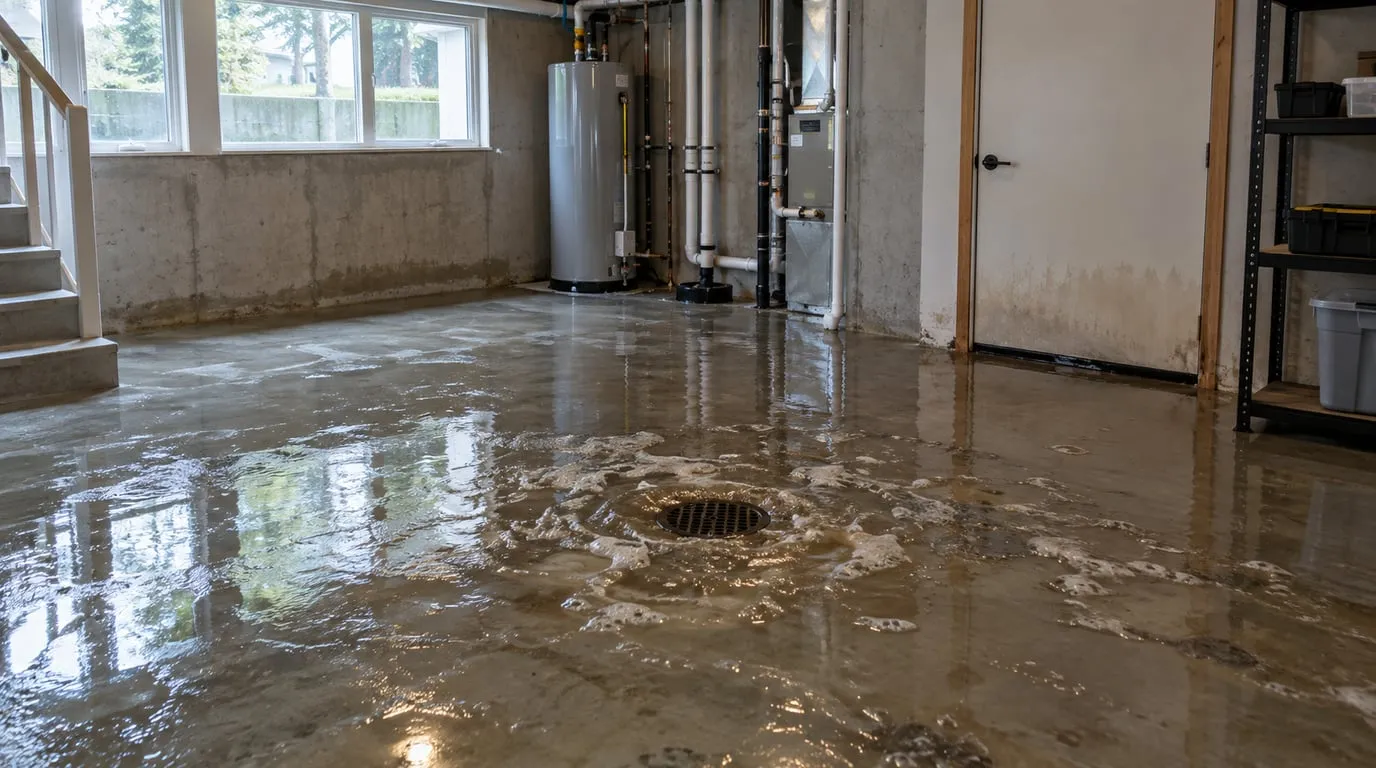
Quick answer: Sewage backup cleanup starts with stopping all water use in the house and keeping people and pets out of the affected rooms. A plumber clears or repairs the line, and a restoration crew extracts the wastewater, removes porous materials it soaked into, disinfects what remains, and dries the structure. Sewage is treated as the most contaminated category of water damage no matter how clear it looks.
What causes a sewage backup?
Wastewater leaves the house through a single main drain line. When that line is blocked or overwhelmed, sewage comes back up through the lowest opening, which is usually a floor drain, a basement shower, or a ground-floor toilet.
The common causes:
- A clog in the main line. Grease, wipes, and paper products build up over time until the pipe closes off.
- Tree roots. Roots find joints in older clay and cast iron pipe and grow into a mat that catches solids.
- A damaged pipe. Sections can crack, separate, or sag as soil settles, which leaves a low spot that collects debris.
- An overloaded public sewer. During heavy rain, some municipal systems take on more water than they can carry and push it back toward connected homes.
- Septic system failure. A full tank or saturated drain field leaves wastewater nowhere to go.
The pattern tells you a lot. Gurgling in several drains, a toilet that bubbles when the washing machine drains, or water rising in the lowest fixture when someone runs a tap upstairs all point to the main line rather than one fixture.
What should you do in the first hour?
- Stop using water. Every flush, shower, and appliance cycle adds to the backup. Do not keep flushing to test the drain.
- Keep everyone out. Close the door, and keep children and pets away from the area.
- Stay clear of electrical hazards. If water is near outlets, appliances, or the electrical panel, do not walk through it. Shut off power to the area only if you can reach the breaker from a dry spot.
- Turn off the HVAC system if the affected area has return vents, so contaminated air is not pulled through the house.
- Call a plumber and a restoration company. One fixes the cause and the other handles the contamination. You need both.
- Photograph the damage from a safe distance before anything is moved.
The CDC’s floodwater guidance lists sewage and electrical hazards among the main risks of contact with contaminated water. Do not run a household vacuum or point fans across wastewater, and avoid carrying wet boxes through clean rooms. All three spread contamination.
Why is sewage handled differently from a clean water leak?
Restoration work follows the IICRC S500 standard, which sorts water into three categories by contamination. Sewage is Category 3, the highest, because it can carry bacteria, viruses, and parasites. We cover the full scale in our guide to water damage categories.
The category changes the work. A clean supply-line leak can often be dried in place. Category 3 water cannot, because drying alone leaves the contamination behind in whatever absorbed it. That is also why a toilet overflow is handled very differently depending on whether the water came from the supply side or from the drain.
What can be cleaned and what has to be replaced?
The dividing line is whether a material is porous. Hard surfaces can be cleaned and disinfected. Materials that absorb water generally cannot be made reliably clean after soaking in sewage.
| Material | Usual outcome after sewage contact |
|---|---|
| Carpet and pad | Removed |
| Drywall and insulation that got wet | Removed to above the wet line |
| Laminate, particleboard, and MDF cabinets | Removed |
| Upholstered furniture and mattresses | Usually discarded |
| Sealed concrete, tile, and metal | Cleaned and disinfected |
| Solid wood framing | Cleaned, disinfected, and dried |
| Hard-surface contents | Cleaned and disinfected |
Ask the crew to explain each removal decision. A written scope should show the affected boundaries, what is being removed and why, how the remaining structure will be cleaned, and how drying will be verified with moisture readings. A repaired sewer line says nothing about whether the inside of the house is ready to rebuild.
Does homeowners insurance cover a sewage backup?
Often not by default. Many standard homeowners policies exclude water that backs up through sewers or drains unless the policy includes a water backup endorsement, and that endorsement usually carries its own limit. Our guide to water backup coverage explains how the endorsement works.
Report the loss with the facts as documented: where the water came from, when it started, and what the plumber found. The cause determines which policy terms apply, so keep the plumber’s findings with your claim records.
How does the response differ by city?
The cleanup standard is the same everywhere, but the usual causes and the affected spaces vary.
- Dallas and Fort Worth. Expansive clay soil shifts with wet and dry cycles, which stresses drain lines running under slab foundations. Older homes with cast iron drains are the most exposed. Because most homes sit on a slab, backups tend to show up in ground-floor bathrooms and spread across finished flooring. See our Dallas water damage guide and the Dallas service area.
- Nashville. Intense rain can overload sewers in the older parts of the city, and finished basements often hold stored belongings and utility equipment right beside the lowest drain. Tell the plumber about any gurgling or slow drains that came before the backup. See flood cleanup in Nashville and the Nashville service area.
- Seattle. Long wet seasons mean rain seepage and a drain backup can happen in the same daylight basement at the same time, and each needs a different fix. Note where water appeared first and which fixtures reacted. See our Seattle water damage guide and the Seattle service area.
- Tucson. Dry desert air does not sanitize a sewage spill or prove that a wall cavity is dry. Tile floors are common, which helps, but the lower walls, cabinets, and anything porous still need assessment. See our Tucson water damage guide and the Tucson service area.
We also have city guides for sewage backups in Phoenix, Salt Lake City, and Las Vegas.
Getting help
Bingham Restoration handles sewage extraction, removal of contaminated materials, disinfection, and structural drying as part of our water damage restoration service, and we document the loss for your insurer. A live dispatcher answers around the clock at 520-FLOODED (520-356-6333).
Frequently Asked Questions
How do I know whether the clog is in my line or the city sewer?
One slow fixture usually points to a branch clog inside the home. If several fixtures back up at once, or the lowest drain overflows when you run water upstairs, the main line is involved. A plumber's camera inspection shows whether the blockage sits in your lateral or beyond it. If neighbors have the same problem at the same time, report it to the sewer utility.
Is it safe to stay in the house during sewage cleanup?
It depends on how much of the home is affected. A backup confined to one closed-off room is often manageable with containment in place. If wastewater reached the HVAC system, the only bathroom, or the main living area, most households are better off staying elsewhere until cleaning and drying are finished, especially with young children, older adults, or anyone with a weakened immune system.
When is a sewage spill small enough to clean up without a crew?
A small spill on tile or sealed concrete that never touched carpet, drywall, or cabinetry can be handled with waterproof gloves, boots, eye protection, and a disinfectant, followed by thorough drying. Once sewage has soaked into porous materials or spread beyond one small area, it calls for professional extraction, removal, and disinfection.
How long does sewage cleanup take?
Extraction and removal of contaminated materials usually happen in the first day or two. Structural drying generally adds three to five days, and repairs follow after the structure is verified dry. Larger losses, crawlspaces, and jobs waiting on a sewer line repair take longer.
Will the sewage smell go away once everything is dry?
Only if the contaminated material is gone. Odor that lingers after drying usually means wastewater reached something that was left in place, such as carpet pad, the bottom of a wall cavity, or the subfloor under a cabinet. Deodorizing over it does not fix the source.
Need Emergency Restoration Right Now?
Our crews arrive in 48 minutes on average and bill your insurance directly.
Call 520-FLOODED